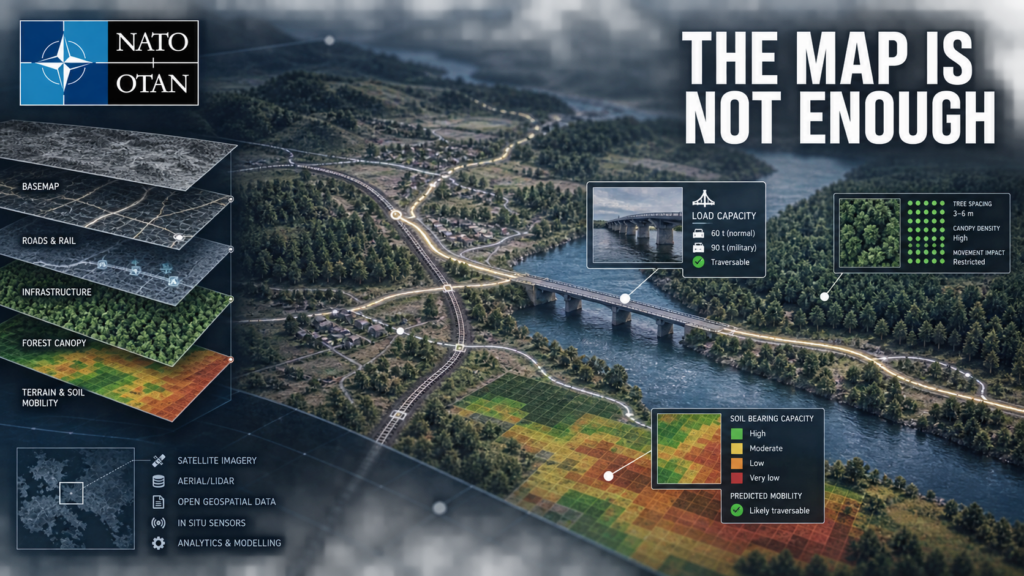
The NATO Communications and Information Agency (NCIA) has issued a request for information asking industry for wide-area or global geospatial datasets that can support military operations, according to Geoawesome. The request, RFI-191786-GEOOPS, is market research rather than a tender or contract award, with responses due September 22, 2026, and participation limited to companies from NATO member countries.
NCIA identified three priority areas: soil, transportation and forest land cover. For soil, NATO wants seamless global or wide-area data comparable with 30-metre resolution. The transportation requirement goes beyond road geometry, asking about military load classifications, road clearance, surface and subgrade strength, bridge condition, rail loading gauges, staging facilities, and connections between road, rail, air and maritime networks. Forest data is expected to describe tree type, stem spacing, trunk diameter, branch height and canopy closure — attributes that help assess whether terrain can be crossed or bypassed.
For every proposed dataset, vendors must document provenance, update cycles, coverage, production time, quality assurance, metadata and attribute schemas, plus compatibility with NATO's CoreGIS environment. They must also price two licensing models: use within the NATO enterprise, and broader use by NATO nations and approved non-NATO entities.
The RFI sits alongside a separate NCIA procurement for a Global Seamless Vector Basemap Data Package, a planned contract valued at an estimated €3.5 million and compliant with the NATO Geospatial Information Framework, with a solicitation planned for October 2026. Geoawesome notes that existing civilian datasets — including Overture Maps' transportation graph, ESA WorldCover's 10-metre land-cover mapping and ISRIC's 250-metre SoilGrids — could contribute to a solution but don't individually cover everything NATO is asking for, meaning commercial vendors may compete on their ability to fuse open, national and proprietary sources into a defensible operational product.
The procurement also ties into NATO's Alliance Data Sharing Ecosystem, which five nations tested during Bold Quest 2026; NATO has said that exercise exposed barriers involving data quality, access and speed. NCIA has not disclosed a budget, acquisition timetable or accuracy thresholds for the operational datasets it is scoping.