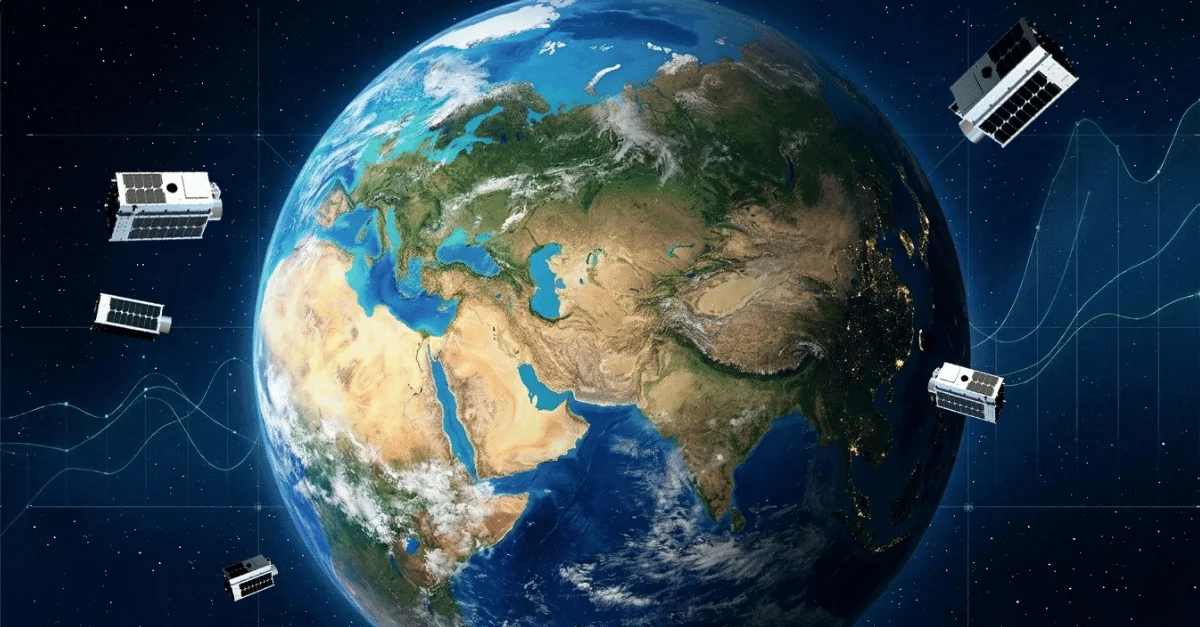
GHGSat has unveiled plans for a second-generation methane-detecting satellite, a decade after the Montreal-based company launched the world's first high-resolution satellite of its kind. The new satellite is scheduled to reach orbit in early 2028.
The Gen2 satellite will detect onshore methane emissions at a threshold of 50 kilograms per hour, compared with 100 kg/hr on GHGSat's original satellites. Daily coverage per satellite will double as well, from 10,000 square kilometers to 20,000 square kilometers, while data delivery will remain within 24 hours, which GHGSat describes as the industry's fastest turnaround.
"Our second-generation satellite is the next step in a decade of delivery: the next evolution of the only commercially operating, independently validated methane monitoring constellation in the world," said Stephane Germain, GHGSat's Chief Executive Officer. "The satellite builds on the same peer-reviewed, independently validated science that has made GHGSat the partner of choice for the world's largest industrial operators."
GHGSat says its first-generation constellation observed more than 4 million industrial facilities and detected more than 20,000 emissions events in 2025 alone, with daily revisit capability at any site. The company also points to independent validation of its data from institutions including Stanford, ESA, METEC and NASA.
Gen2 is designed to work alongside GHGSat's DATA.AIR aircraft sensor, which the company says reaches detection thresholds approaching 3.5 kg/hr at a 90% probability of detection under METEC-validated testing. Together, GHGSat describes the combination as a multi-tier "tip-and-cue" system that layers satellite and airborne data with the Sentinel-5P mission.